
Cadaqués · Costa Brava
Salvador Dalí House-Museum in Portlligat: Ultimate Cadaqués Visiting & Ticket Guide
Last updated: October 8, 2026
In a sun-bleached, sleepy fishermen's village, tucked away in the easternmost point of Spanish Costa Brava, there's a hidden gem not many tourists and art lovers reach — Salvador Dalí's house and residence, where he lived, worked, and filled his cup with inspiration and creativity.
In this article
I went to his Figueres theater-museum a year ago, and it has been one of the places I learned about way before visiting Spain. I remember, while I was in college, there was a book called Life of Salvador Dalí (opens in new tab) that got into my hands, and from the first couple of chapters it became obvious that Dalí had quite a personality, which made me obsessed with his phenomenon first, and only after that, the second subject of interest was his art. I wanted to learn more about what had influenced him from his early years to make him the persona he is, and who those figures were who made an impact on his life trajectory and unrivaled glory.
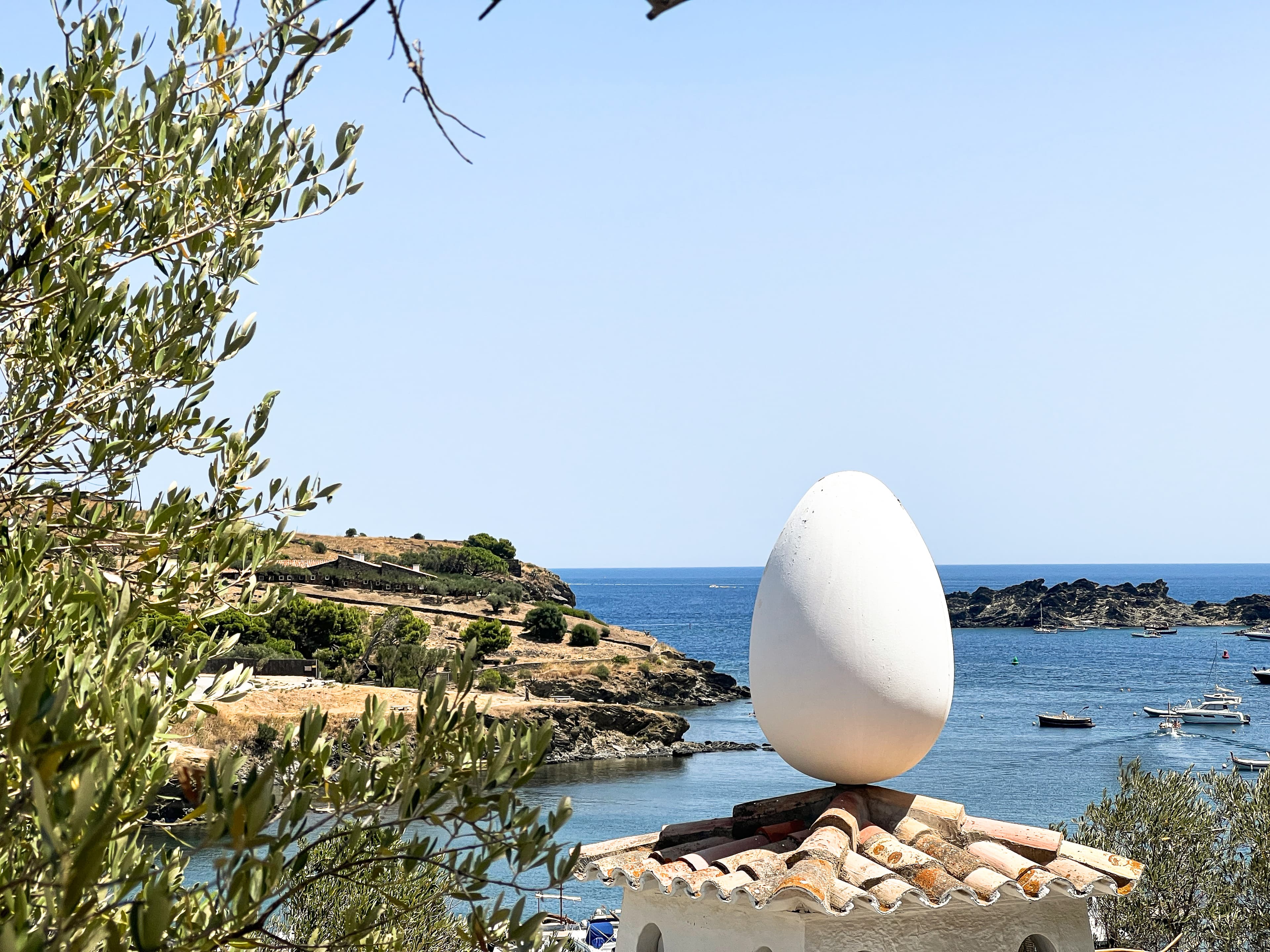
Once in Figueres, I was walking around this grand municipal old theatre turned private artist museum that thinks of art as something that requires full immersion — when the art is not limited to just a picture, but continues beyond and travels to the walls and the space that contains it. There, in Figueres, I was walking down the hall and saw a picture on the wall of a whimsical building with an egg-shaped roof element that interrupted my walk for a second. I learned that it was Dalí's residence in Costa Brava in Port Lligat, a tiny fishing village a short walk from Cadaqués, where he actually created most of his work. I made a note that I should go there one day, just because of how beautiful that area was — it served as an inspiration for his art.

This July, I finally went there and stayed in Cadaqués for a weekend to explore it beyond the museum. In this article, I'm sharing practical and honest tips on how to plan your visit to Cadaqués and what you should know and plan ahead before hitting the road!
Salvador Dalí House-Museum (Portlligat) vs. Dalí Theatre-Museum (Figueres)
The "Dalí Triangle" (Portlligat, Figueres, & Púbol)
Salvador Dalí was born on May 11, 1904, in Figueres, Spain. Figueres is special to him because it was his lifelong hometown, the landscape that inspired his surrealist art, and the site of his ultimate artistic monument. This is the most well-known and recognised museum that everyone goes to. However, there are three important Dalí residences:

Portlligat
Private home and studio
His office, his place for experiments and thinking.

Figueres
Dalí Theatre-Museum
His main art museum that later became his tomb.

Púbol
Gala Dalí Castle
Her medieval retreat.
Is the Portlligat House-Museum worth visiting?
I nearly missed this museum as it's the one that is further away, and not that many people actually know about it — it stays completely under the radar. Another reason for it attracting less attention is that Portlligat doesn't represent Dalí's art and has only a few artworks in his study that haven't been finished. What makes Portlligat interesting is its sophisticated design full of little elements and curiosities, which was previously a set of small fishermen's cabins stitched together, continuously improved and polished across 40 years.


How to Book Salvador Dalí House-Museum Tickets (Portlligat)
Booking essentials
- •Advance booking is mandatory — no walk-up tickets in peak season
- •Book 3–5 days ahead minimum (June–September)
- •Pick up your ticket at the ticket office at least 30 minutes before your slot — or it is forfeited, no exceptions, no refunds
- •Groups enter every 10 minutes, accompanied by a guide
- •Photos are allowed (no flash); video recording is prohibited
There's a mandatory advance booking with strict time slots. I recommend booking 3–5 days in advance to secure a ticket. Don't rely on walk-up tickets, as they sell out for the same day, especially during peak months (June–September).
One very important thing that I nearly forgot myself: the museum explicitly asks you to pick up your entry ticket 30 minutes before your reserved slot, or your tickets are forfeited. It would be really sad.

Entry is restricted to small groups that are allowed to enter every 10 minutes accompanied by a guide. As the place has very narrow walkways and a complicated, leveled structure, you're given a few minutes to spend in one room before you're allowed to proceed to the next one. You can not go back there on your own after finishing the excursion, so I recommend you focus and look around at all the details whenever you're in the room.
Photos are allowed without flash, but any video recording or filming is prohibited.
What's Inside the Salvador Dalí House-Museum & Studio?
The Bear Hall, Temple Bedroom and Gala's Oval Room
The second you walk into the house, you find yourself in the cramped entrance hall, Rebedor de l'Ós (Bear Hall), greeted by a gigantic taxidermy bear, adorned with a crown and jewelry, holding a torch in one paw, with a wooden tray hanging on his neck for cards, keys, letters, and all little things that usually get lost around the house. That's such a clever arrangement for a catchall!


The polar bear was a gift from Edward James, a wealthy British eccentric, poet, and major patron of the Surrealists — who also helped fund Dalí's artistic endeavors and famously co-created the Lobster Telephone.
Further along the path lies the principal bedroom shared by Dalí and Gala, a room that feels more like a theatrical temple than a classic bedroom. What struck me the most was that little element I noticed all around the house: bouquets of dried yellow flowers adorning the curtain line, the headrests, and framing mirrors. Our guide told us these were immortelles (Helichrysum strawflower), which Gala Dalí used to decorate the house — yellow as her signature, dried compositions embodying immortality in response to Dalí's perpetual obsession with time, decay, and the fear of mortality.

One of the most unique things in this room is a carefully calculated position of a mirror that captures the first strokes of the rising sun. Dalí placed a mirror on the opposite wall from his bed so he could see the sunrise right from his bed while waking up, and since Portlligat is located at the easternmost point of mainland Spain, that famously made him the first Spaniard to see the sun rise every morning.


We proceeded to Gala's Oval Room (El Saló Oval), tucked away on the back of the house, which served as a very intimate and private space for Gala, for reading and reception. The first thing you notice is the oval dome that reminds you of a sea urchin — yes, sea urchin, not an egg as every source tells you, as confirmed by our guide — with little holes that serve as windows. The sitting area is organized with built-in banquettes upholstered in soft fabrics with Russian-inspired cushions (paying homage to Gala's heritage), low wooden tables, and dried flower arrangements. Dalí loved sea urchins because they are soft and vulnerable on the inside, protected by a hard outer structure. By sitting inside the room, you are symbolically resting inside the protective shell. He viewed Gala as a fragile spirit who needed a hard, protective shell to shelter her from the outside world. Besides that, he had childhood memories connected with these creatures — growing up along the rocky shores of Cadaqués, Dalí used to eat live sea urchins right off the rocks.

Our guide suggested we try out the acoustics of this room — due to its spherical, domed architecture, the room functions as a natural whisper gallery or echo chamber.
Dalí's Painting Studio
I stepped into the studio and immediately understood why Dalí stayed here for decades. His original easels, palettes, and unfinished canvases are still exactly where he left them, giving the whole room a strange, frozen-in-time feeling. Then I spotted the real oddity everyone tells you to look for: a subterranean floor slot fitted with a mechanical winch, which he used to lower and raise his massive canvases while painting — seated, without ever having to stand up.

The Outdoor Courtyard, Olive Grove & Surrealist Swimming Pool
Stepping back outside, the surrealism only ramps up. The Alhambra-inspired swimming pool is surrounded by pure kitsch — oversized Michelin Man figures, vintage Pirelli tire signs, and enough surrealist clutter that I forgot for a second I was standing in someone's garden. From there, I wandered through the Olive Grove, its terraced paths lined with giant white egg installations and framing panoramic views out toward Cap de Creus.


Tucked into this outdoor section, I found The Garage (Garatge: Sala Audiovisual, designated as Room 18 on the official museum map) — a small screening room where you can watch the documentary produced by the Gala-Salvador Dalí Foundation. It weaves together archival footage, historic photographs, and interviews exploring Dalí's life, his creative process, and how the surrounding Cap de Creus landscape shaped his art and private life with Gala. Since The Garage sits within the outdoor circuit — right alongside the terraced olive trees, the summer dining area, and the pool — you can duck in and watch it self-paced, either before or after your timed tour through the house interior.
How to Get to the Dalí House in Portlligat from Cadaqués & Barcelona
Since I chose a hotel right next to the Dalí house in Portlligat (opens in new tab), it took me a few minutes of walking uphill — which is rewarded by a view of the fishermen's bay of Portlligat, olive groves, and Dalí's sculptures in the garden. If you're staying in central Cadaqués, I recommend taking a scenic 15–20 minute uphill-downhill walk (1.2 km) along the historic path.
For the full rundown of where to stay across Cadaqués' neighborhoods — waterfront, old town, and the quieter Port Lligat/Cap de Creus area — check out my complete Cadaqués travel guide.
If you're travelling by car or passing by Cadaqués on your road trip, there are a few parking options for you:
Portlligat Beach Parking (Closest to Museum)
Open in Maps (opens in new tab)Directly behind the Portlligat beach cove — Avinguda Paratge S'Alqueria / P4 Portlligat
Back-Up Plan: Cadaqués Campsite Parking
Along Avinguda de Salvador Dalí, opposite Camping Cadaqués and next to the town cemetery
How to Get to Cadaqués by Public Transportation
From Barcelona: Direct buses depart from Barcelona's Estació d'Autobusos Nord. The trip takes about 2 hours and 45 minutes, running several times a day year-round, with increased frequency in summer.
From Girona: Buses depart from the main Girona Bus Station (Estació d'Autobusos, right next to the train station). The ride takes about 1 hour and 45 minutes, but schedules can be limited — often just once a day on weekdays, and rarely on weekends.
Booking your bus
The most convenient app for checking all buses and trains is Omio (opens in new tab) — compare routes and book directly in the app. Or book through the transport company's website, Moventis (opens in new tab). Either way, get your ticket in advance and just show the QR code to the driver to board.
Read next
8 Best Things to Do in Cadaqués, Spain + Where to Stay
Dalí's home, Cap de Creus hikes, boat tours, and where to stay in this hidden Costa Brava gem.
Final Words: Is It Worth Visiting Cadaqués and Salvador Dalí's Museum in Portlligat?
Given the fact that Cadaqués is a little out of the way, I definitely recommend visiting — it is 100% worth the effort and your time, and deserves a place in your itinerary. Whether you're on a road trip across Spain, or starting in Spain and heading to France, Cadaqués is one of the most charming places with a well-preserved atmosphere that's hard to replicate elsewhere.


Salvador Dalí's Museum in Portlligat is a place not many people know about, and it opens up to you his universe of surrealism and kind of lets you see the world through his lens — whimsical, unusual, and bizarre, but genuinely worth the curiosity. Ideally, visit all museums of the Dalí Triangle, starting in Figueres, followed by the castle in Púbol and finishing with Cadaqués, but I've visited all three museums on three separate occasions, and each one stands completely on its own.
I hope this article was helpful and saved you a bit of time on research and travel planning — that's the whole reason I'm writing this! Happy travels!
Frequently Asked Questions
More things to do in the area
You may also like
The Perfect 3-Day Valencia Itinerary: First-Timer's Guide
Where to Stay in Ortigia, Sicily
How I Walked the Camino de Santiago Portuguese Coastal Route in 10 Days
Some of the links on this site are affiliate links. This means I may earn a small commission if you purchase them at no extra cost to you. I only recommend things I genuinely use or believe in.