Mexico | Mexico City
10 Best Things to Do in Mexico City (And 2 Things to Skip)
The first time I got the chance to get on the plane to Mexico City was on the verge of Christmas, and it colored and shaped the whole time I spent there over the next couple of weeks. Seeing this hustling and bustling city light up with Christmas lights, adorned in the red of poinsettias in every corner flower shop, I could walk for hours, losing track of time, catching the aromas of crispy-roasted al pastor for tacos and café de olla with freshly fried churros.
A few years later, I visited Mexico City again for New Year's, when the whole city turned into a massive techno party. For me, Mexico City has so many things folded in, like a good mix of contemporary, young art and culture, deeply inspired by Aztec tribal heritage, and a pinch of Hispanic culture. This city feels incredibly young, and it's so massive that you could spend years trying to get to know it. However, you don't have to, as here comes this guide: a curated selection of all the best Mexico City has to offer! In this article, I'm sharing the 10 best things to do in Mexico City and 2 things I would definitely skip.
In this guide
Things to Know About Mexico City Before Your Arrival
1. Mind the elevation
Mexico City is over a mile above sea level (an elevation of 7,350 feet = 2,240 meters), which is hard to believe, and you can barely see it, as the city is so massive, with a population of over 20 million people, that you never see its edges. However, the first thing I noticed when walking up the street was feeling short of breath, like I sometimes get hiking in the mountains. Thing to remember: you might feel a little fatigued in the first few days after you arrive, so give yourself some time to acclimatise, drink plenty of water, and pace yourself if you're going uphill, as you would in the mountains.
2. Bring layers
Mexico City has a great climate all year round; it's very sunny in winter, with temperatures staying at 21°C (70°F) during the day, but it changes dramatically after 8 PM and drops to 8°C (46°F) at night. As I arrived with my European summer wardrobe, I felt great during the day, but had to shop for more layers and got a jacket to feel warm when going out in the evening.
3. Avoid drinking tap water
Tap water is not drinkable in Mexico City, so the first thing we did upon arrival was stock up on bottled water, which is usually sold in big gallon jugs in supermarkets, and use it for cooking, making coffee, and drinking.
Quick-Reference Cheat Sheet
| Experience / Activity | Neighborhood / Area | Advance Booking Needed? | Monday Warning (Closed?) |
|---|---|---|---|
| 1. National Museum of Anthropology | Chapultepec Park | Recommended (skip-the-line) | Closed Mondays |
| 2. Chapultepec Castle | Chapultepec Park | Walk-up or online | Closed Mondays |
| 3. Frida Kahlo Museum (Casa Azul) | Coyoacán | Mandatory (weeks ahead) | Closed Mondays |
| 4. Centro Histórico & Templo Mayor | Centro Histórico | Only for Templo Mayor | Zócalo & Bellas Artes open; Templo Mayor closed |
| 5. Street Taco & Market Crawl | Roma Norte / Centro | Optional (for guided tours) | Open daily |
| 6. Sunrise Hot Air Balloon at Teotihuacán | 1 hour north of CDMX | Mandatory | Open Mondays |
| 7. Lucha Libre Wrestling Match | Doctores (Arena México) | Recommended | Runs Tue, Fri & Sun |
| 8. Xochimilco Trajinera Canals | Xochimilco (South) | No (hire at embarcadero) | Open Mondays (calmer) |
| 9. Sunday Car-Free Cycling (Muévete en Bici) | Paseo de la Reforma | Free (rent Ecobici) | Sundays only (08:00–14:00) |
| 10. Café Hopping & Gallery Strolls | Roma Norte & Condesa | No | Open daily |
The 10 Best Things to Do in Mexico City
1. Stand Before the Aztec Sun Stone at the National Museum of Anthropology
This is a massive building, located in Chapultepec Park off Av. Paseo de la Reforma. Use Google Maps to find it, as the park itself is very large and has a few other museum buildings that might confuse you.
I put it first on the list for a reason: it's widely considered one of the greatest archaeology museums in the world, and when you're there, standing in front of the Aztec Sun Stone (Piedra del Sol), it would be hard to disagree. This museum is often called the Louvre of Latin America; this is how important it is.
The best advice I could give is to skip the first rooms and start at Room 4 (Teotihuacan), as this is where the deeper history of these civilizations starts to take shape. Focus on the ground-floor Mexica (Aztec) and Maya halls rather than trying to conquer all 23 rooms in one go; museum fatigue is real and sets in after a couple of hours. If you feel tired, take breaks to chill outside on a courtyard bench and drink some water for 5–10 min, and then resume.
How to get there: Take an Uber, or reach the museum via Metro Line 7 (Auditorio station) or Metro Line 1 (Chapultepec station), then walk 10–15 minutes through the park.
Time required: 2.5 to 3 hours, and go right at opening (09:00).
2. Take a Walk Down to the Terraces of Chapultepec Castle
Right after the Anthropology Museum visit, we walked through Chapultepec Park, and as I mentioned briefly before, it spreads out over 866 hectares / 2,140 acres, and it could take hours to walk down every winding path. We headed right towards Chapultepec Castle, passing a long line of people waiting for tickets. We didn't get tickets online beforehand, as I wasn't prepared to spend a couple more hours at another museum; instead, we walked up to the terraces of Chapultepec Castle, which are completely free to enter.
It's the only royal castle in North America, perched atop Chapultepec Hill with mind-blowing views straight down Paseo de la Reforma: a great place to take a couple of pictures.
Personal tip: Pair this with the Museo de Arte Moderno (MAM) (opens in new tab) on the same morning, since both are inside Chapultepec Park (just remember both close on Mondays).
3. Step Inside Frida Kahlo's Casa Azul & Wander Coyoacán
The first time I stayed in Mexico City, I ran out of time to book tickets; you should look into booking them 2–3 weeks in advance if you don't want to miss it. Many people come to Mexico City solely to visit Frida's house, and I eventually went there too, when I came back a few years later. In the time in between, I read 300+ pages of Frida Kahlo's biography (opens in new tab), which gave me plenty of context on her life and the struggles she lived through, including her very fragile health and the love affairs reflected in her art.
Tour the cobalt-blue home where Frida Kahlo lived and painted, preserving her studio, personal dresses, and folk-art collection.
Beyond the museum, there's plenty to see in Coyoacán, so while you're down there (a 40-min ride from Roma Norte), take advantage and explore it a bit. Walking down the streets of Coyoacán always makes me feel like this is what Mexico City must have been like when Frida was around. If you happen to be in Coyoacán in the evening, one way to get acquainted with it is food stall hopping, trying filled churros, esquites (corn in a hearty broth topped with mayo, smoked paprika, and cilantro), tacos de canasta (steamed tacos filled with potatoes, beans, chicharrón), and buñuelos (crispy fried dough balls covered in cinnamon powder).
Walk the cobblestone streets of Coyoacán to Mercado de Coyoacán for tostadas, grab coffee with churros at Café El Jarocho (opens in new tab), and use your Casa Azul ticket for free entry to Diego Rivera's volcanic-stone Museo Anahuacalli (opens in new tab) nearby (it's free, but they charge a fee of 30 MXN for personal photos with a phone or camera).
4. Walk Centro Histórico from the Zócalo to Palacio de Bellas Artes
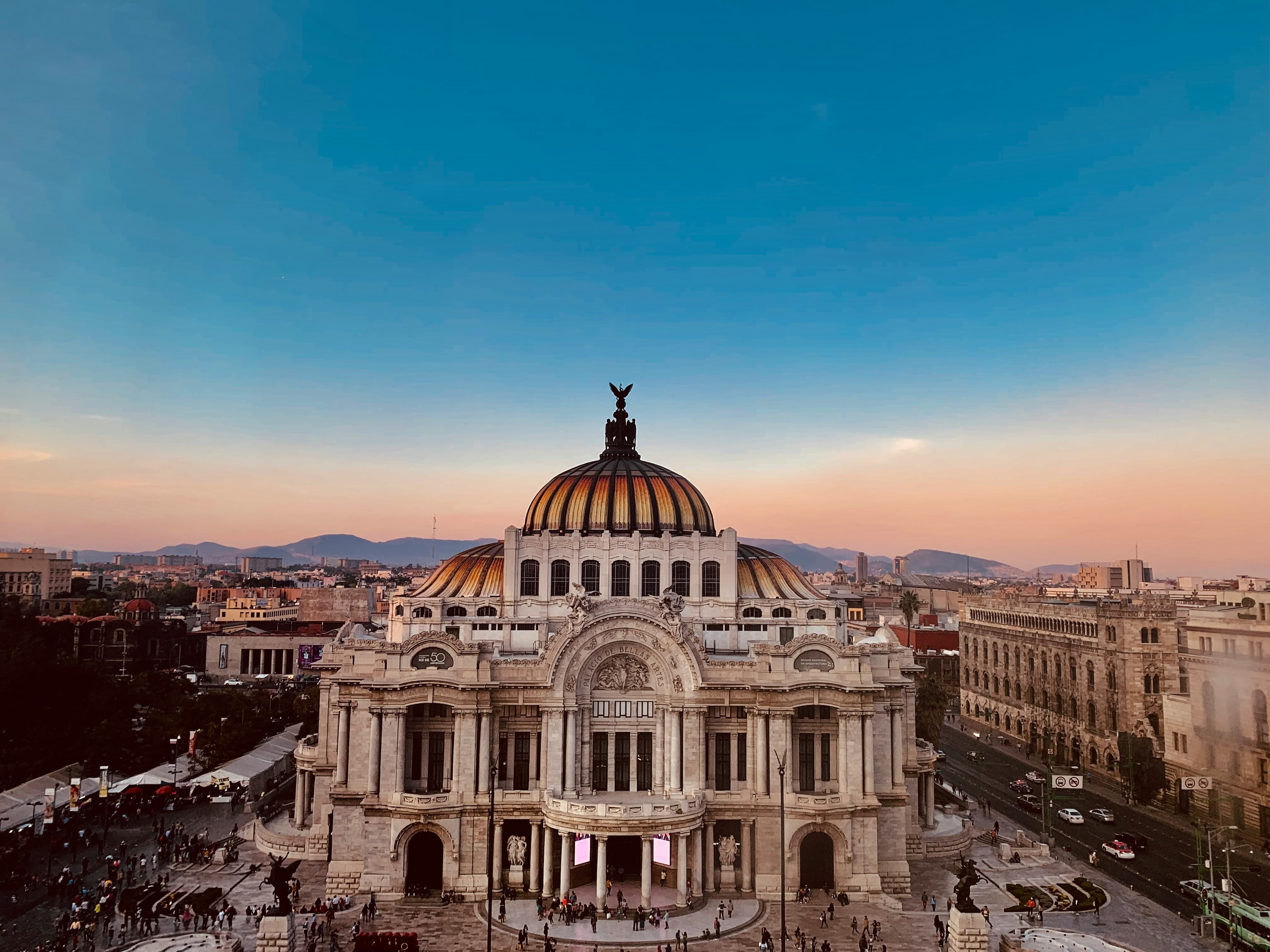
The best route, the one we found ourselves going back to, was to start in the massive Zócalo plaza, step inside the Metropolitan Cathedral, walk past the excavated Aztec ruins of Templo Mayor, and admire the Art Nouveau marble exterior of Palacio de Bellas Artes.
If you have time that day, Palacio de Bellas Artes itself is worth a visit: it has one of the biggest collections of 20th-century murals, including important works by Diego Rivera like Carnival of Mexican Life (opens in new tab) (1936) and La tercera internacional (Russian Revolution, 1933).
Insider viewpoint: Grab a coffee on the 8th floor of the Sears department store directly across from Bellas Artes for an unobstructed balcony view of the palace's orange-and-gold dome without paying observation-deck fees.
5. Go on a Street Taco & Traditional Market Crawl
I have to confess that we did this probably 3 times a week, and tried and tested almost every popular taco spot: al pastor carved straight off the vertical trompo, crispy suadero, tacos de canasta (basket tacos), and fresh churros with hot chocolate at Churrería El Moro.
My favorite taco places:
- •Orinoco in Roma Norte (opens in new tab): one of the best al pastor tacos in town; get them with baked potatoes on the side.
- •Tacos Atarantados Condesa (opens in new tab): get the mixed plate of trompo meat tacos with a shot of mezcal.
Best market stops: Explore Mercado de Jamaica (famous for massive flower aisles and street food) or Mercado de San Juan for exotic local ingredients.
6. Float Over Teotihuacán in a Hot Air Balloon at Sunrise
This is something I would do over and over again, despite the early wake-up, a high chance of cancellation due to weather conditions, and a generally high accident risk. I know not that many people actually talk about it, but hot air balloons are indeed in the high-risk transport category. We did serious research and chose the tour company with the best reviews. It was so breathtaking and stunning to see the sunrise over the pyramids, but I was really worried about the landing part! In the end it all went so smoothly: we landed as light as a feather, carefully caught by the staff waiting for us on land, who directed the basket for a smoother landing.
Leave CDMX before dawn to drift over the Avenue of the Dead (opens in new tab), the Pyramid of the Sun, and the Pyramid of the Moon as the sun rises over the valley, followed by walking the archaeological site on foot.
Monday hack: Unlike city museums, Teotihuacán stays open on Mondays, making it the smartest day of the week to schedule your trip.
7. Catch a High-Flying Lucha Libre Match at Arena México
I was a little skeptical at first, as I'm just not someone who has fun watching MMA and men punching each other, but in the end we gathered a group and headed straight to the match. What convinced me was a big cup of juicy michelada that I saw in photos! The match was fun, a little theatrical, and in the end nothing like anything I've seen before; something about it was deeply Mexican (well, the crowd was 99% local). Masked luchadores, theatrical entrances, passionate local crowds yelling lucha chants, and cold micheladas in the Doctores neighborhood (matches run Tuesdays, Fridays, and Sundays at Arena México).
It's better to either walk (if you live in Roma) or arrive via Uber/DiDi directly at the arena entrance, and afterwards walk a little further down the street to order a ride home and avoid the crowds.
8. Cruise the Aztec Canals of Xochimilco on a Trajinera
When I was taken to Xochimilco for the first time, I had no idea what I was getting into. It's unlike anything else we've done in Mexico City, yet it's something many locals do every weekend, which calmed me down, as I was afraid it would be a tourist trap. It ended up being anything BUT that, and looked like a traditional Mexican alternative to Venice. Float through the last remnants of Tenochtitlan's ancient canal system aboard brightly painted wooden trajinera boats while floating mariachi bands and food vendors pull alongside.
How to do it right: Book with a group (boats are priced per hour instead of per person, so you can share the ride with everyone) and aim for the quieter ecological reserve canals rather than just the main party strip.
If you're travelling solo but don't want to miss out on the fun, check out these group experiences: a fun mezcal tasting (opens in new tab) or a quieter kayak tour (opens in new tab).
9. Cycle Car-Free Paseo de la Reforma on Sunday Morning
I didn't actually know it was a thing until I noticed, while walking around on a Sunday, that the major avenues get shut down to give full access to bicycles, restricting cars from entering. The event takes place every Sunday from 08:00 to 14:00, and it's called Muévete en Bici.
You can join by grabbing an Ecobici bike-share pass and riding past the Angel of Independence alongside thousands of locals, rollerbladers, and dog walkers. There's nothing more fun to do on a sunny day than being outside and cycling down the major avenues of the city, not worrying about cars getting in the way.
10. Slow Down with Café Hopping & Architecture Walks in Roma & Condesa
For me, Mexico City is all about just wandering around with no plan and exploring the streets of leafy, artistic neighborhoods like Roma and Condesa. What we loved doing every Sunday was spending an unscheduled morning walking the leafy median of Avenida Ámsterdam and Parque México in Condesa, then crossing into Roma Norte for specialty coffee and a pastry at Panadería Rosetta. The guava roll is something everyone is hunting for; I've tried it and can confess it's worth the hype, big time.
2 Things to Skip in Mexico City (And What to Do Instead)
Skip #1: Paying to Go Up the Torre Latinoamericana Observation Deck
Long elevator lines, pricey admission tickets, and crowded glass windows are just not worth it, plus you lose the most iconic skyscraper in the skyline because you're standing inside it.
What to do instead: Head to the 8th-floor café inside Sears across from Palacio de Bellas Artes for a coffee with a close-up dome view. One of the best terraces with a view that I found is Supra Roma Rooftop (opens in new tab), great for late-night drinks, overlooking a skyline that almost looks surreal due to its scale, which puts into perspective how massive CDMX really is.
Skip #2: Showing Up to Frida Kahlo's Casa Azul Without Timed Tickets
This is exactly what I did! Well, kind of: I knew I wouldn't get in without a ticket, so I went down to Coyoacán to walk around and explore the neighborhood. I showed up at the gate anyway to check if I could buy a walk-up ticket, with no luck. Tickets are only sold online in timed slots and sell out weeks in advance. I ended up visiting Trotsky's house-museum that day, where Frida spent lots of time as well; it was curious to see how a Russian exile lived after fleeing from the Revolution.
Another alternative is to check out Casa Estudio Diego Rivera y Frida Kahlo in San Ángel (the iconic twin red-and-blue Bauhaus studio houses connected by a rooftop bridge), which rarely requires booking weeks ahead and offers an equally intimate look at their creative lives.
Essential CDMX Planning Rules
1. Essentially, all museums are closed on Mondays
That makes Monday a good day to visit Teotihuacán, Xochimilco, Museo Soumaya (which is open and free to visit), or to do neighborhood walking tours.
2. Extra hydration required
At 2,240 meters, alcohol and steep stairs hit harder. I felt it immediately, so what helped me feel better was drinking extra water (sometimes with electrolytes) and pushing big hikes to at least two days after a big night out or a mezcal bar visit.
3. Holidays and important dates to plan your trip around
- •Día de Muertos (October 31 – November 2): The most visually iconic time to visit CDMX. Expect giant ofrendas (altars) in the Zócalo, marigold-covered streets, and the Grand Day of the Dead Parade along Paseo de la Reforma. Book flights and boutique hotels 4–6 months ahead. I constantly regret that I always miss it and come right after the event; this one is worth planning your whole trip around!
- •Mexican Independence Day (September 15–16): The evening of September 15 features the presidential Grito de Dolores ceremony and fireworks in the Zócalo, followed by a massive military parade on September 16. Expect major street closures around Centro Histórico and Reforma.
- •Semana Santa / Holy Week (March 21–28, 2027): One of the highest-impact domestic travel weeks. Interestingly, because millions of chilangos leave the city for the coast, CDMX becomes noticeably calmer and less congested, though some family-run shops close on Good Friday (March 26).
- •Día de la Virgen de Guadalupe (December 12) & Guadalupe-Reyes Season (Dec 12 – Jan 6): Millions of pilgrims converge on the Basilica of Guadalupe in northern CDMX on December 12, kicking off three weeks of posadas, festive lights, and seasonal Rosca de Reyes pastries through Epiphany on January 6.
- •3-day long weekends (puentes): Mexico shifts several statutory holidays to Mondays, including Constitution Day (Feb 1, 2027), Benito Juárez's Birthday (Mar 15, 2027), and Revolution Day (Nov 15, 2027). Expect popular nearby escapes (Teotihuacán, Tepoztlán, Puebla) to see heavier weekend crowds.
- •Jacaranda season (late February – April): Not an official holiday, but arguably the best weather and visual window of the year, when purple jacaranda trees canopy the streets of Roma Norte, Condesa, and Reforma.
Final Word
Mexico City is a true gem that has its rough edges: a long history of not being the safest place in the world, and accusations of being too big, crowded and polluted. But on the bright side of things, I always found Mexico City artsy, unique and quirky, with lots of character and culture, the nicest hardworking, hospitable and warm people, and the most delicious cuisine, represented by both $2 food-stall tacos and $200 Michelin-acclaimed dinners, where both versions would surprise you with their taste and creativity. I fell in love with this city, and I made a promise to come back for Christmas at least once every 5 years. Hopefully, I'll plan it to catch El Día de Muertos one day. What a dream! I hope this was helpful. Enjoy your time exploring this lovely place; I'm sure you'll love it as much as I did!
FAQ
Read next
Things to Do in Oaxaca: A Local Foodie & Culture Guide
From market feasts and mezcal crawls to Monte Albán and rooftop sunsets, here are the best things to do in Oaxaca, Mexico.